绿茶
The Unruliness of Large-Leaf Tea: A Cup of Dian Green, an Echo of the Wilderness
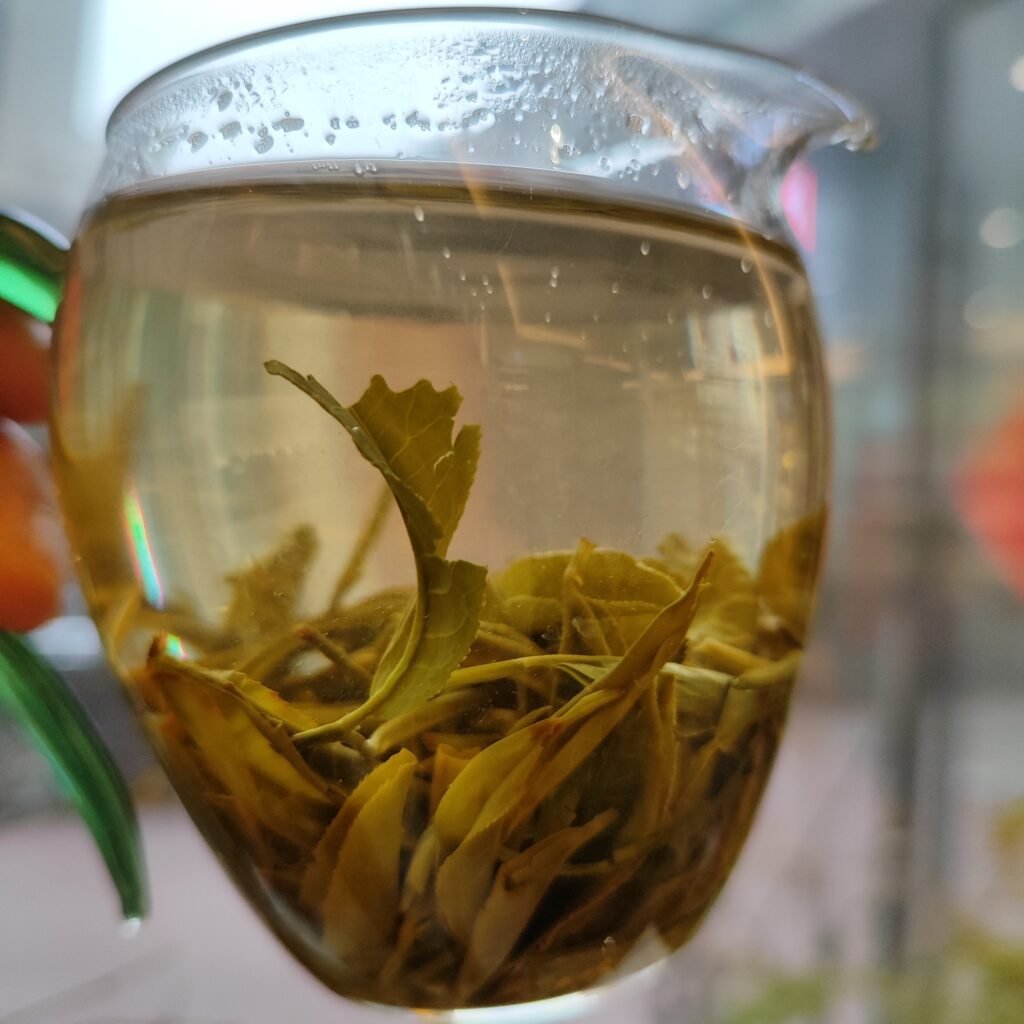
When it comes to Yunnan tea, most people think of the aged depth of Pu'er or the sweet richness of Dianhong black tea. But I have a soft spot for a lesser-known tea—Dian Green, or Yunnan large-leaf baked green tea.
The first time I tasted Dian Green was at a modest little tea shop in the ancient town of Dali. The owner, a sun-tanned local, casually grabbed a handful of tea leaves from a burlap sack and tossed them into a gaiwan. The leaves were coarse and large, with a greenish-yellow hue—nothing like the delicate, refined appearance of Jiangnan green teas. I quietly wondered: could this really be good tea?
Boiling water rushed in, and he poured out the infusion after just five seconds. That first sip completely overturned my understanding of green tea. There was no nutty aroma of Longjing, no tender freshness of Biluochun. Instead, a rich, direct, and robust flavor hit me—earthy and wild, like the scent of mountain grass and trees, traveling from the tip of my tongue straight down to my throat. In that moment, I felt as if I were standing in a tea garden on Wuliang Mountain, the wind sweeping through the canyon, carrying the warmth of the sun and the fragrance of soil.
This is Dian Green—green tea made from Yunnan's large-leaf varietal, the very same raw material used for Pu'er. Its polyphenol content is several times higher than that of small-leaf varieties, so naturally, its flavor is much more "aggressive." Those accustomed to the subtle elegance of Jiangnan greens are often taken aback by Dian Green's intensity: the bitterness comes swiftly, and so does the sweetness that follows—like a rugged mountain man who speaks his mind without pretense.
But Dian Green is far more than just bold. A fine Dian Green, especially the early spring tea harvested before Qingming, reveals layers of aroma: a fresh, bean-like fragrance in the first steep, gradually giving way to floral and fruity notes in the second, and a faint, cooling sweetness lingering in the later infusions. As the leaves unfurl in the cup, they reveal their thick, fleshy texture—as if the entire vitality of a mountain spring had been condensed into each sip.
Later, I learned that Dian Green and raw Pu'er share the same origin. The only difference lies in the drying process—Dian Green is baked at high temperatures to lock in its freshness and vibrant green color, while sun-dried green tea (or "shaiqing") is left to dry under sunlight, allowing room for aging and transformation. One pursues "freshness," the other "age"—born of the same source, yet destined for entirely different paths.
Now, whenever I brew Dian Green, I use water at around 95°C and pour it out quickly, never letting it steep too long. Watching those coarse, sturdy leaves rise and fall in the cup, as the liquor gradually shifts from pale green to a clear, translucent yellow-green, I feel a deep sense of grounding. It lacks the delicate refinement of famous teas, yet carries the openness and sincerity of Yunnan's vast mountains and rivers. One sip—bold, mellow, with a lingering sweetness—and I am reminded that this land never hides its true flavor; it simply gives its very best, all in a single cup.
Just as the beautiful jasmine flower gently graces the world, this untamed Dian Green stirs the soul. One softens time; the other dazzles the moment.